I employ a broad range of techniques to extrapolate information from geologic samples that can inform us about how our Earth's outermost layer evolves through time. Some of these techniques include but are not limited to:

(U-Th)/He THERMOCHRONOLOGY

REFLECTANCE SPECTROSCOPY

U-Pb GEOCHRONOLOGY

REMOTE SENSING AND MAPPING - ArcGIS, ENVI

X-RAY MICROCOMPUTED TOMOGRAPHY

MICROSCOPY
MY RESEARCH
Long-Term Evolution of the Southern San Andreas Fault
My research investigates how deformation along the southern San Andreas Fault system shapes crustal exhumation and topography. Using apatite and zircon (U-Th)/He, apatite fission-track, and zircon U-Pb geochronology, I reconstructed cooling and uplift histories across the San Andreas restraining bend. These data show that spatial variations in exhumation correlate with differences in fault dip and connectivity, linking near-surface uplift patterns to deeper plate-boundary geometry. find out more in Rojas et al., Tectonics, 2025
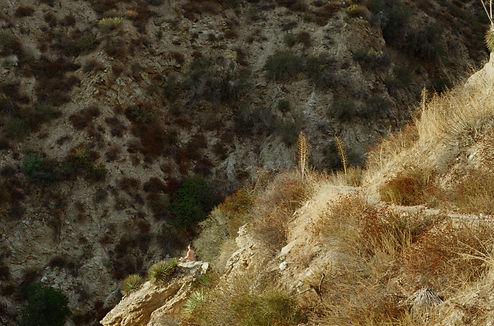

Ultramafic Weathering & Carbon Cycling
Tectonic uplift can expose fresh ultamafic rocks that draw down CO₂ as they weather, and some have linked pulses of mountain building to long-term global cooling. But in many places, stay exposed far longer than predicted from laboratory dissolution experiments. My work explores why? what controls how fast olivine dissolves in nature, and how weathering products might slow the process down.
I combine field observations from the Twin Sisters Range (WA) with laboratory spectroscopy, XRD, and SEM to track how iron oxide coatings form and how they change mineral reactivity over time. This project helps clarify the role of ultrmafic terrains in long term carbon cycling and why some of Earth's most reactive rocks may weather more slowly than predicted.


